
Wildfire smoke, your windows, your siding, and why washing isn’t vanity — it’s math
Poor Man Window Cleaning — Boise, Meridian, Eagle, Nampa, Caldwell, Kuna, Star. Since 2002.
Open your front door this morning. Go ahead. I’ll wait.
You taste it.
Metallic. Campfire that went wrong. Sits on the back of your tongue and doesn’t leave.
You feel it on your skin. That fine grit on your forearms when you walk to the truck.
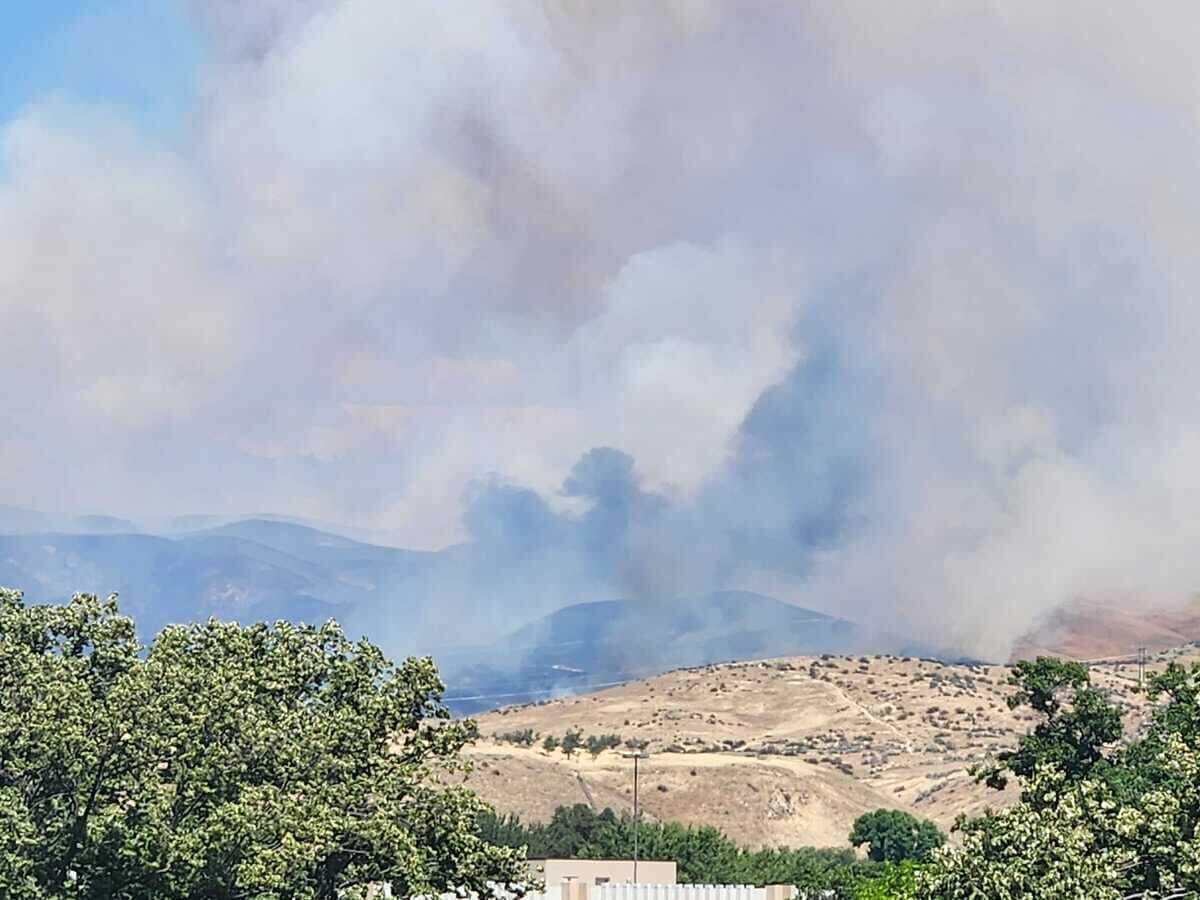
That’s the Powder River Fire, Baker County, Oregon — northwest of Weiser, past 20,000 acres. That’s the Claremont Fire in our own Foothills. That’s a lightning bust that lit 85-plus fires across Oregon and turned into more than 200,000 acres burning. Northwest wind. Funnels right down the valley and parks on top of us.
Nampa hit 166 on the Air Quality Index this week. That’s Unhealthy. Not “unhealthy for sensitive groups.” Unhealthy. Everybody. DEQ has an air quality advisory posted for Ada, Canyon, Gem, Payette, and Washington counties.
Here’s the part nobody’s telling you.
That smoke doesn’t stay in the air.
Gravity Is Undefeated
Everything that goes up comes down.
You wash your car after a smoke week. Everybody does. You see the film on the hood. Gray. Slick. Chalky under your finger. You don’t argue with it. You just go wash the car.
Now look up.
Same air. Same particles. Same week.
Your house has roughly forty times the surface area of your car. It doesn’t get a garage. It has been standing out in this, day and night, since the first plume showed up.
It’s on your siding. It’s on your windows. It’s packed into your screens. It’s coating your solar panels. It’s silting up your gutters.
You just can’t see it as easy, because your house is big and the human eye is lazy about big things.
What’s Actually Landing On You
Wildfire smoke isn’t smoke the way a birthday candle is smoke.
When a forest burns, that wood goes through pyrolysis — thermal decomposition. Big word, simple idea. Heat rips the wood apart chemically before it ever gets a chance to burn clean. What comes off the top is a soup.
Three ingredients in that soup matter to your house.
Particulate. PM2.5. Particles under two and a half micrometers across. Thirty times smaller than a human hair. Small enough to settle into the pores of your paint and the micro-scratches in your glass and just — stay there.
Creosote and tar. The sticky organic fraction. Volatile compounds that boiled off the wood, rode the thermal column up, cooled, and condensed back into a liquid film on the first cold thing they touched. That’s the same stuff that lines a chimney flue. It’s greasy. It’s brown. It bonds.
Ash. And this one’s going to cost you money.
Ash Is Not Dirt. Ash Is a Base.
Regular dirt is chemically boring. It sits there. It waits. You rinse it and it leaves.
Wildfire ash is potassium and calcium carbonates and oxides. The minerals the tree pulled out of the ground over eighty years, concentrated down into powder.
Add water — dew, sprinkler overspray, a monsoon cell rolling through — and it dissolves and goes alkaline. pH nine. Sometimes pH twelve.
pH twelve is oven cleaner.
pH twelve is drain cleaner.
pH twelve is lye.
Your house is currently wearing a thin coat of homemade lye, and it re-wets itself every single morning when the dew falls.
It gets better. Ash is hygroscopic — it pulls moisture out of the air all by itself. So it does not dry up and blow away like you’re hoping. It stays damp. It stays reactive.
Chemists call that dwell time. How long a chemical gets to sit on a surface and do its work. Every hour of dwell time is another hour of attack. Right now the clock is running, and nobody’s watching it.
What It Does To Your Glass
Glass is silica. Silicon dioxide. Looks solid. Acts solid. But it has one real enemy.
Alkali eats silica.
That’s not my opinion. That’s why concrete crews go pale when slurry splashes a window. Sustained alkaline contact etches glass — it dissolves the surface unevenly and leaves permanent micro-pitting.
Looks like a haze. Looks like a film. You scrub it, and it doesn’t come off.
Because it isn’t on the glass anymore. It is the glass now.
There’s no chemical that undoes etched glass. There’s mechanical cerium polishing, if you can find somebody who does it right, and there’s replacement. Dual-pane, low-E, argon-filled units in this valley run $200 to $800 a window installed. Big picture windows and specialty shapes go past that.
And your warranty doesn’t cover it, because it isn’t a seal failure. It’s a chemical exposure. That’s on the homeowner.
Wash it off in a couple weeks, you spent a little money on a window cleaning. Let it ride till October and you’re getting glass quotes.
What It Does To Your Siding and Paint
Paint is a polymer film. Engineered to shed rain and eat UV. It was never engineered to hold a caustic poultice for ninety days.
Alkaline residue saponifies the binders in the coating. Saponify — same root as soap. It literally begins converting your paint film into soap. What you see is chalking, fading, and a flat, dead look that no amount of washing brings back, because the gloss layer is gone. It didn’t get dirty. It got consumed.
On vinyl, the ash pits the surface, and the second that surface goes porous the oxidation accelerates. Vinyl siding is UV-stabilized right up until the stabilizer package runs out. Abrasion and alkaline attack burn through it early.
On fiber cement — Hardie board, which is half of Meridian and Eagle at this point — the trap is different. Fiber cement is thirsty. It’s cement. It wicks. Smoke residue soaks into the coating and into the board, and once it’s in there you’re not washing it out. You’re repainting.
Exterior repaint on an average Treasure Valley home: $4,000 to $12,000.
A house wash is a rounding error against that number.
Your Screens Are Filters Now
Nobody thinks about this one. I’ve been doing this since 2002 and it still surprises people.
Window screen is a woven mesh. A woven mesh with fine airborne particulate blowing through it for three straight weeks is, functionally, an air filter. It loads. It clogs. It holds.
Then it cools off one night in August, you crank the windows open, and you pull outside air straight through a loaded filter into the room where you sleep.
You bought a HEPA unit for the living room. Good. Meanwhile there’s a filthy pre-filter installed on every opening in the house and nobody’s serviced it since the Fourth of July.
Your Solar Panels Are Just Quietly Losing You Money
Photovoltaic panels convert light into power. Anything sitting between the sun and the cell is a tax.
Industry term is soiling loss. Ordinary summer dust in this valley costs you five to ten percent. Wildfire ash — fine, sticky, hygroscopic, cemented down hard by dew cycles — routinely runs fifteen to twenty-five percent. I’ve metered worse.
That’s production. That’s your net metering credit. That’s actual dollars leaving through the roof every sunny day while you’re at work.
And the anti-reflective coating on that panel glass? Same alkaline etching problem as your windows, except now the damage is sitting directly in the light path. Permanently.
And Then There’s the Gutters
Ash plus water equals sludge. A whole season of it equals a plugged downspout.
Then that September monsoon cell hits, the gutter can’t move the water, it sheets over the front lip, and now you’ve got saturated soil stacked against your foundation and water running behind your fascia.
That’s a rot problem.
Rot problems do not get cheaper with time. Nothing about a house does.
The Part Where I Tell You What To Actually Do
Rinse it before it cures.
That’s the whole ballgame. Everything I just described runs on a clock. Chemistry needs time to do damage. Take the time away, you take the damage away.
Please do not go rent a pressure washer and fix this yourself. I mean that with love. Thirty-plus years in, the most expensive messes I’ve been called out to repair were homeowners with good intentions and 3,000 PSI. High pressure drives water behind lap siding, where it stays. It shreds screens. It strips paint. On fiber cement it’ll blast the texture right off the board and you’ll see the stripes forever.
The right tool is soft washing. Low pressure — garden hose pressure — with proper surfactants and a chemistry that actually neutralizes and lifts alkaline residue instead of smearing it around. The chemistry does the work. The water just carries it off. Your house doesn’t take a beating.
Windows get hand-detailed, or run with pure water — reverse osmosis and deionization, zero dissolved solids in the rinse — so it dries with nothing left behind. No spots. No film. Nothing left on the glass to re-bond and start the clock over.
Screens come off and get washed separately. Washing a screen in the frame just packs the grime into the corners.
Panels and roofs get their own approach entirely, because they should.
We’re Right Here
Poor Man Window Cleaning. Boise, Meridian, Eagle, Nampa, Caldwell, Kuna, Star, Middleton, Garden City — the whole Treasure Valley, since 2002.
Your friendly neighborhood grime fighters.
We’re booking smoke-season washes right now, and I’ll shoot you straight: after every bad smoke stretch the phone goes sideways for about three weeks and then we’re out a month. The folks who call while the air is still bad get on the calendar. The folks who wait until the leaves turn are calling me about etched glass, and by then I can’t help them — I can only give them a phone number for somebody with a glass truck.
You wash your car.
Wash your house.
It is the single largest investment you will ever make, it’s standing out in this right now, and it can’t ask you for help.
Call or text for a free quote. We’ll tell you straight what it needs — and what it doesn’t.